学校2015
Chinese researchers identify target to develop depression drug using traditional ethnic medicine in Yunnan_我的网站

A |
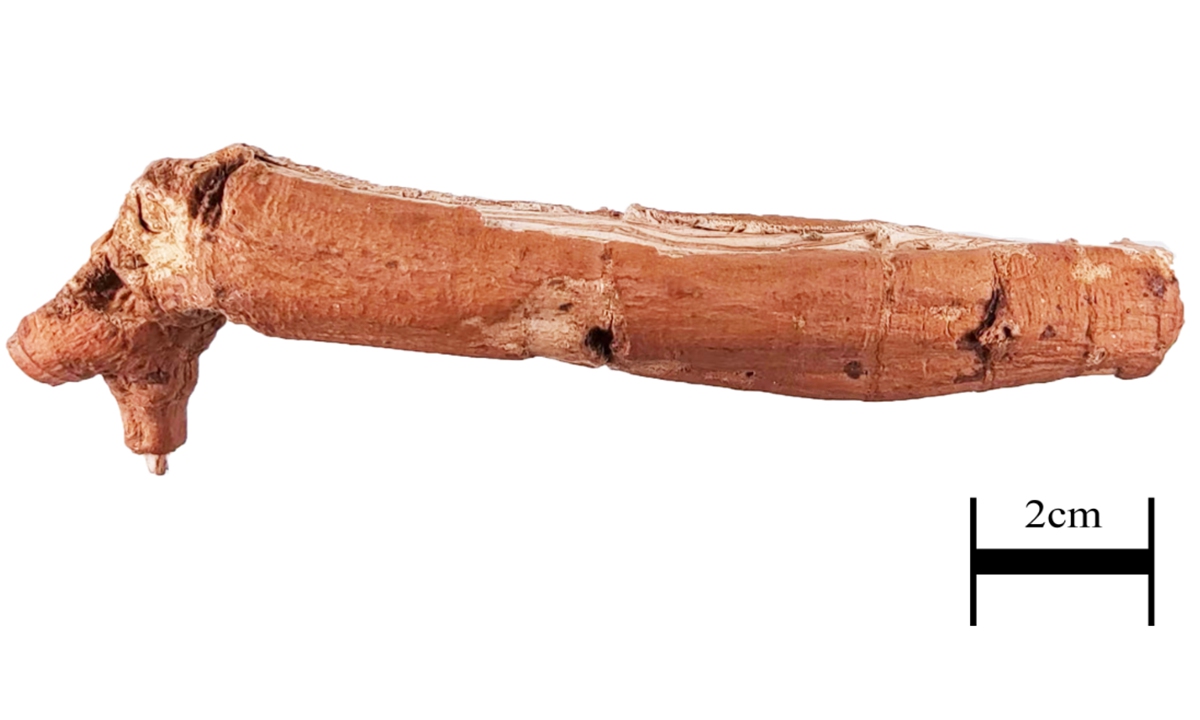
Qingyangshen, or Root of Auricledleaf Swallowwort, a traditional ethnic medicinal plant long used in Southwest China's Yunnan Province. Photo: Scrrenshot from website
A Chinese research team has identified a new potential target to develop antidepressant drug from Qingyangshen, or Root of Auricledleaf Swallowwort, a traditional ethnic medicinal plant long used in Southwest China's Yunnan Province, according to Kunming University of Science and Technology, Science and Technology Daily reported Sunday.
The team, led by professors Xu Tianrui and Xiang Cheng from the university's School of Life Science and Technology, found that Qingyangshen glycosides, the plant's core active compound, can alleviate depression-related behaviors by simultaneously suppressing inflammation, reducing oxidative damage and stabilizing neurotransmitters in the brain.
The findings were published in the international journal Phytomedicine.
Depression has become a widespread mental health disorder globally, while existing clinical drugs fail to provide effective treatment for more than 30 percent of patients, according to the researchers. Previous studies have established a strong link between chronic inflammation and depression, but existing anti-inflammatory drugs have limited targeting capabilities, underscoring the need for new therapeutic targets and lead compounds.
Qingyangshen, a plant of the Cynanchum genus in the Apocynaceae family, has long been used as a traditional medicine by ethnic groups including the Naxi, Yi and Bai peoples in Yunnan, mainly for treating neurological conditions such as epilepsy and neurasthenia.
The researchers systematically examined the pharmacological effects of Qingyangshen extract and its core active compound, Qingyangshen glycosides. Tests using mouse, zebrafish and fruit fly models repeatedly showed that the compound significantly improved depression-related behaviors induced by inflammation, according to the report.
To identify the compound's target, the team developed a dual-discrimination model for four subtypes of prostaglandin E2 receptors and combined it with AI-powered machine learning. The researchers screened hundreds of G protein-coupled receptors and identified the prostaglandin E2 subtype 4 receptor as the direct target of Qingyangshen glycosides.
Multiple molecular experiments confirmed that the compound binds directly to the receptor and acts as an inhibitory ligand. Further experiments involving animals with the receptor knocked out in the hippocampus showed that the antidepressant effects of Qingyangshen glycosides disappeared completely when the receptor was absent, providing the first in-vivo evidence that the receptor is essential for the compound's therapeutic effects.
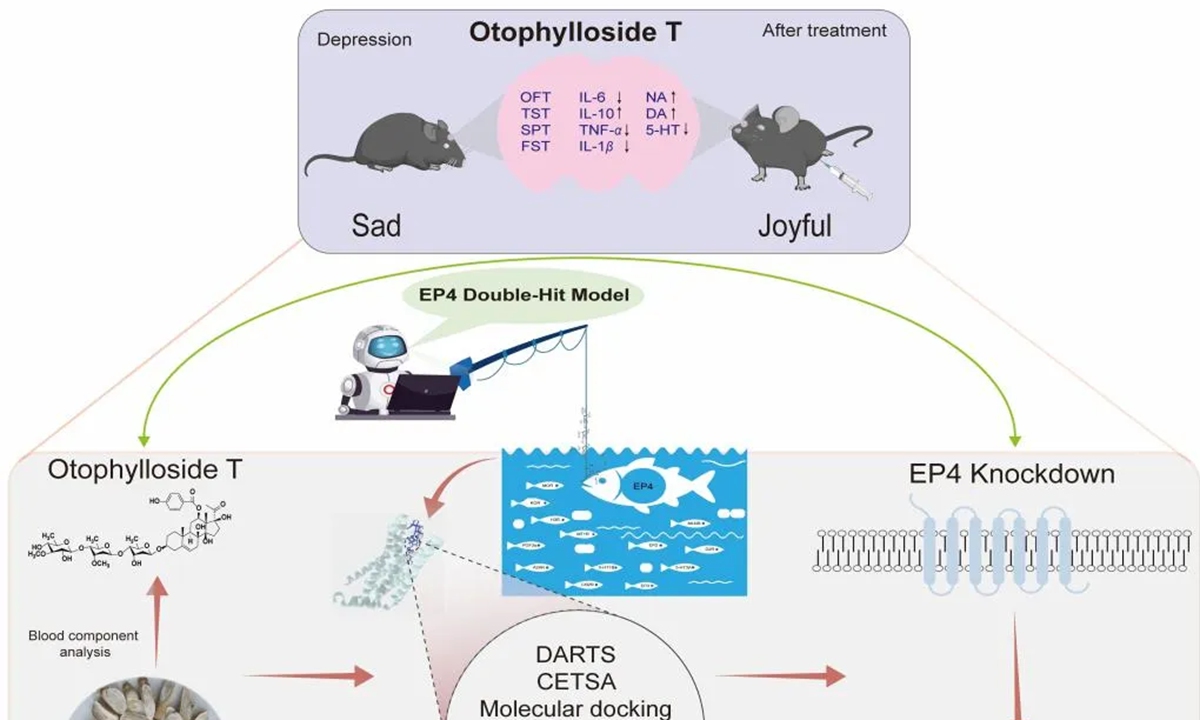
An illustration of the research. Photo: Screenshot from the website
The study establishes the prostaglandin E2 subtype 4 receptor as a potential new target for antidepressant drug development and points to a new approach to treating depression through inflammatory pathways. It also identifies Qingyangshen glycosides as a potential lead compound for developing highly targeted anti-inflammatory antidepressants, creating a research chain from ethnic medicinal plants and active compounds to drug targets and new drug development.
Global Times
。 Under construction since 2011, the GERD project is one of the largest public infrastructure projects in Ethiopia, and will be the biggest hydroelectric power plant on the African continent once finished next year.,The third phase of the filling of a massive reservoir, capable of holding up to 74 billion cubic meters of water, was completed this week, with two of the dam’s planned 16 turbines now operational. When construction is finished, the dam will be capable of generating some 6,000 megawatts of power – more than double the average output of a WER-1000 nuclear reactor.,AfricaWATCH Water Pour Over Spillway on Ethiopia’s GERD Hydroelectric Dam After Finishing Third FillingYesterday, 22:33 GMT,In a ceremony inaugurating the project on Friday, Ethiopian Prime Minister Abiy Ahmed stressed that the dam was Ethiopia’s “gift,” and that it was “Ethiopia’s responsibility to use it” together with the other two Nile Basin countries - Egypt and Sudan.,“PM @AbiyAhmedAli reiterated that Ethiopia is working to ensure the benefits of the lower basin countries, saying that our Abbay River [Ethiopia’s term for the Blue Nile, one of the two major tributaries of the Nile] takes what it deserves while passing on what others deserve,” the prime minister’s office tweeted following the ceremony.,PM @AbiyAhmedAli reiterated that Ethiopia is working to ensure the benefits of the lower basin countries, saying that our Abbay River takes what it deserves while passing on what others deserve. He also congratulated all Africans on this milestone. (2/2) pic.twitter.com/Be9WtrHczO— Office of the Prime Minister - Ethiopia (@PMEthiopia) August 12, 2022,Just Deserts,The question of which country “deserves” what has been the subject of considerable consternation and debate between the three nations, as has the dam’s potential environmental impact, with Cairo and Khartoum fearing the filling of the 145 meter tall, 1.8 km long dam could threaten the region with droughts and floods. Last month, Egyptian Foreign Minister Sameh Shoukry warned that Cairo would defend its interests using “all means available” at its disposal, and called on the United Nations Security Council to negotiate a legally binding agreement between Egypt, Ethiopia and Sudan on regulating the dam’s operation. Egyptian President Abdel-Fattah El-Sisi earlier called the GERD dispute a “red line” security issue.,Ethiopian Ambassador to Russia Alemayehu Tegenu dismissed these concerns, telling Sputnik last month that Egypt and Sudan were trying to “internationalize and politicize the dam to solve their internal affairs” and assuring that the dam “has no significant harm” for the downstream nations.,WorldEgypt, Sudan Politicising Renaissance Dam Construction, Ethiopian Diplomat Says27 July 2021, 08:23 GMT,Nile River: Giver of Life,Stretching some 6,695 km and covering over 3.3 million square km, the Nile is the longest river in the world, and has played a significant role in regional civilizational development going back to the Ancient Egyptians owing to the rich soil perfect for agriculture created by its annual flooding, and its use as a tool for regional river navigation. Ethiopia’s Blue Nile tributary accounts for a whopping 85 percent of the Nile’s total waters.,Egypt, which receives almost no rainfall, relies on the Nile for more than 90 percent of its freshwater, with eastern Sudan similarly dependent on the river for its economic wellbeing and water and food security.,Legacy of Colonial Meddling,Part of the difficulty of regulating the dispute over the Nile is the lack of a regional agreement regulating the waters’ flow. Addis Ababa is not a party to the 1959 bilateral treaty between Egypt and Sudan dividing the Nile’s waters.,A separate 1929 Nile Waters Treaty between Britain and its then-puppet state of Egypt, plus the territories of what are now Uganda, Kenya, Tanzania, and Sudan provided Cairo the right to veto infrastructure projects up the Nile if they threatened to impact the country’s interests. However, that treaty similarly didn’t apply to Ethiopia, which managed to survive as the only independent nation in Africa after the European imperialist scramble for the continent in the 19th century, and which was never consulted on the agreement’s terms.,Russia’s Position,As a strategic partner of both Ethiopia and Egypt, Russia has sought to assure the dam dispute’s peaceful and mutually amenable resolution, with Foreign Minister Sergei Lavrov indicating in 2021 that Moscow would be ready to provide technical assistance for any negotiations on the matter. Russia also supports the use of the African Union platform to resolve the crisis.,Also last year, Russian Ambassador to the UN Vassily Nebenzia called on the three countries to stick to the terms of the 2015 Declaration of Principles on the GERD, which urged consensus in reaching an agreement on guidelines for the dam’s filling and operation, and committing Ethiopia to avoid steps which could harm its downstream neighbors. “At the same time, we note legitimate concerns of Egypt and Sudan over the possible negative impact that unconstrained functioning of the dam may produce on the populations of those countries in drought prone years,” he said.,The 2015 agreement and efforts at the African Union and UN levels mean that a baseline for a breakthrough and compromise exists. However, amid regional and global concerns about food and water security, and the threats posed by increasingly prevalent climate disasters and extreme weather events, the GERD dispute comes during a period of heightened regional and global tensions.,In 2021, Africa and Middle East intelligence analysis group Pangea-Risk warned that an all-out water war between Ethiopia, Egypt, Sudan, or their proxies was becoming increasingly probable in the face of dwindling options for a mediated solution.。
Current article:http://e78yp3.shangfochengcongshuaizhuang.buzz/list_oexsy3o/dls8.html
Published on:05:25:12

 《流放之路:降临》国服官宣12月转免!9月还有一元畅玩
 网络爆火“骑行四件套”,你中招了吗
 10th Guangzhou Elderly Expo closes with over $106 million in intended cooperation deals
 Oscar-nominated actor Burt Young, of 'Rocky' fame, dies at 83
 新线索:诺基亚9 pureview可能在本月发布
 8月票房破50亿 《龙餐馆》《蜘蛛侠》《八仙》位列前3
查看所有0条评论>>